By Kristie O'Donnell

Every leader has two reputations. The one they've built. And the one people actually experience.
The first lives in the bio, the keynote intro, the carefully worded LinkedIn headline, and the way you describe yourself in a board meeting. It's polished, intentional, and usually impressive. Years of work went into it.
The second lives in the hallway after the meeting. In the text thread between your direct reports. In the silence that follows your town hall when people are deciding whether they believe what they just heard. That reputation isn't built. It's felt.
The distance between those two is what I call the performance gap. And it is the most expensive, least measured problem in leadership today.
AI is widening the gap.
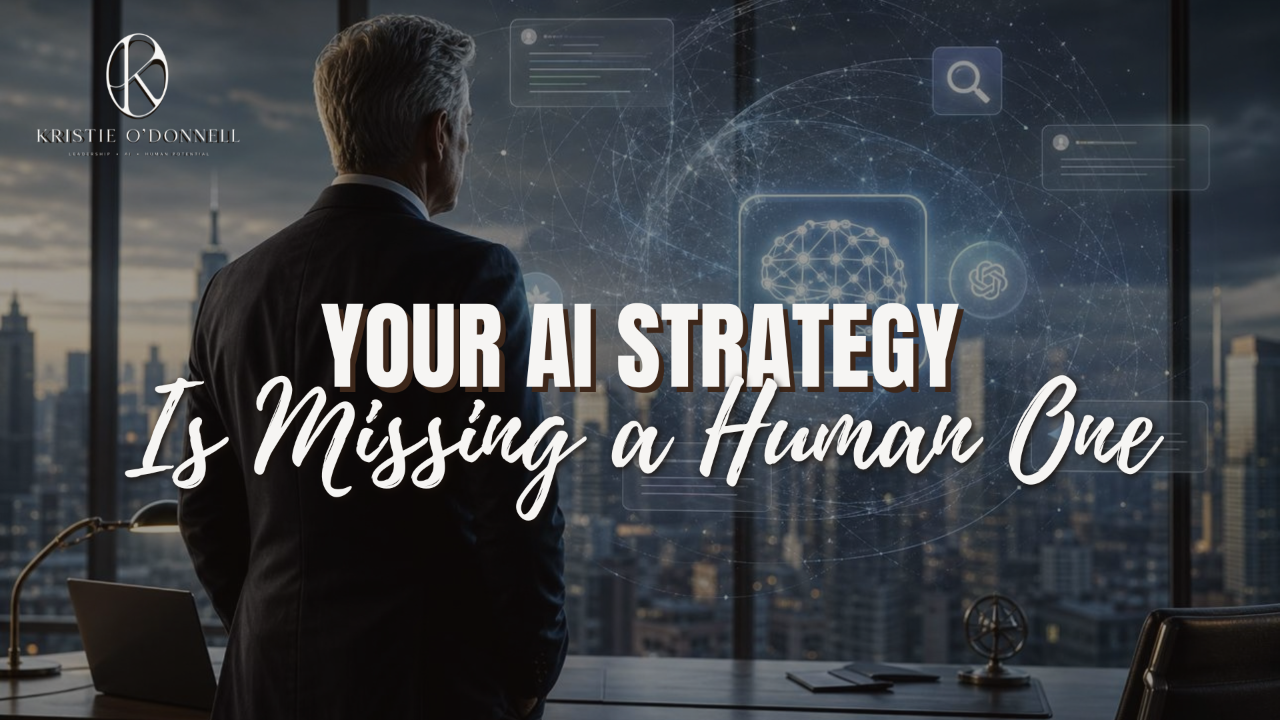
Here's what nobody is talking about. AI has made it easier than ever to perform leadership without actually leading.
You can generate a perfectly calibrated all-hands message in thirty seconds. You can produce a vision document that sounds like it came from a Fortune 50 CEO. You can coach yourself through a difficult conversation with an AI that feeds you the ideal phrasing, the right emotional beats, the language of empathy without the cost of actually feeling it.
The projection has never been more polished. And the gap between that projection and the real experience of working for that leader has never been wider.
People feel this. They may not have the language for it, but they feel it. The message that sounds right but doesn't land. The strategy that's articulate but somehow doesn't move anyone. The leader who checks every box of executive presence but empties a room of its energy.
That's the performance gap in action. And AI is making it worse, not because AI is the problem, but because AI makes the performance so much easier to produce.
The cost is real, and it's measurable.

This is not a soft topic. The performance gap shows up in numbers.
It shows up in attrition. People don't leave companies. They leave the feeling of not being led by someone they believe. And they often can't explain why, which is what makes it so hard to exit-interview your way to the truth.
It shows up in speed. Organizations with high-trust leadership make decisions faster. Not because the decisions are easier, but because people don't need three meetings to figure out whether their leader actually means what they said in the first one.
It shows up in execution. When people believe their leader is the same person behind closed doors as on stage, they run harder. When they suspect the gap, they hedge. They wait. They protect themselves instead of committing.
Every one of those costs compounds. And they all trace back to the same source. The distance between what a leader projects and what people actually experience.
The gap is not about dishonesty.
This is the part that trips people up. The performance gap is not about lying. Most leaders with a wide gap are not being deliberately deceptive. They're doing what they were trained to do.
Executive coaching taught them to manage their presence. Communication training taught them to tailor the message. Leadership development taught them to project confidence even when they don't feel it. The entire professional development industry is, in many ways, a system for widening the gap and calling it growth.
The problem isn't that those skills are useless. The problem is that they've become the whole strategy. And when the projection becomes more practiced than the conviction behind it, people start to feel the difference. Not because they're cynical. Because humans are exceptionally good at detecting incongruence, and no amount of polish overrides that instinct.

Closing the gap is the leadership work of this era.
The leaders I work with who are building something durable right now share one thing in common. They've stopped trying to improve the projection and started closing the gap.
That means saying the thing they actually think before running it through three filters. It means letting their conviction show, even when it's not perfectly packaged. It means being willing to be less polished and more present. Less optimized and more honest.
This is what AQ™ (Authentic Quotience) measures. Not how well you perform leadership, but how small the distance is between your performance and your presence. Between what people hear and what they feel.
The leaders with the smallest gap don't have the best messaging. They have the most trust. And in a world where AI can generate the messaging for everyone, trust is the only advantage that scales.
You can keep widening the gap and hope nobody notices. Or you can close it and watch what happens when people realize the person in the room is the same person they heard on stage.
The second version is harder. It's also the only one that works from here.
Kristie O'Donnell is the creator of the Authentic D.N.AI Code methodology and Authentic Quotience framework and the founder of Polynous. She writes and speaks on what it means to lead as a modern CEO executing with human presence at AI speed.